History
Dirndl is a Bavarian and Austrian dialect word for “girl” or “young woman”; the dress was originally called Dirndlgewand, “girl’s dress”. In the nineteenth century, farm women and female servants in the Alpine region wore a simple, practical dress of this kind: a bodice and skirt of sturdy cotton or linen, with an apron to protect it.
In the late nineteenth century, well-off city families who spent the summer in the Alps (a custom known as Sommerfrische) took up the dress as country-style holiday wear. Tailors and fashion houses began to make finer versions, and by the 1920s and 1930s the dirndl had become a fashion garment in its own right, helped by stage productions and films set in the Alps.
The Nazi regime used Tracht for its ideology, and after 1938 Jewish people in Austria, for example in Salzburg, were banned from wearing it. After the war the dirndl remained popular for a time, then seemed old-fashioned to many younger people. Since the 1990s it has seen a strong revival, particularly around Oktoberfest.
Parts of the dirndl
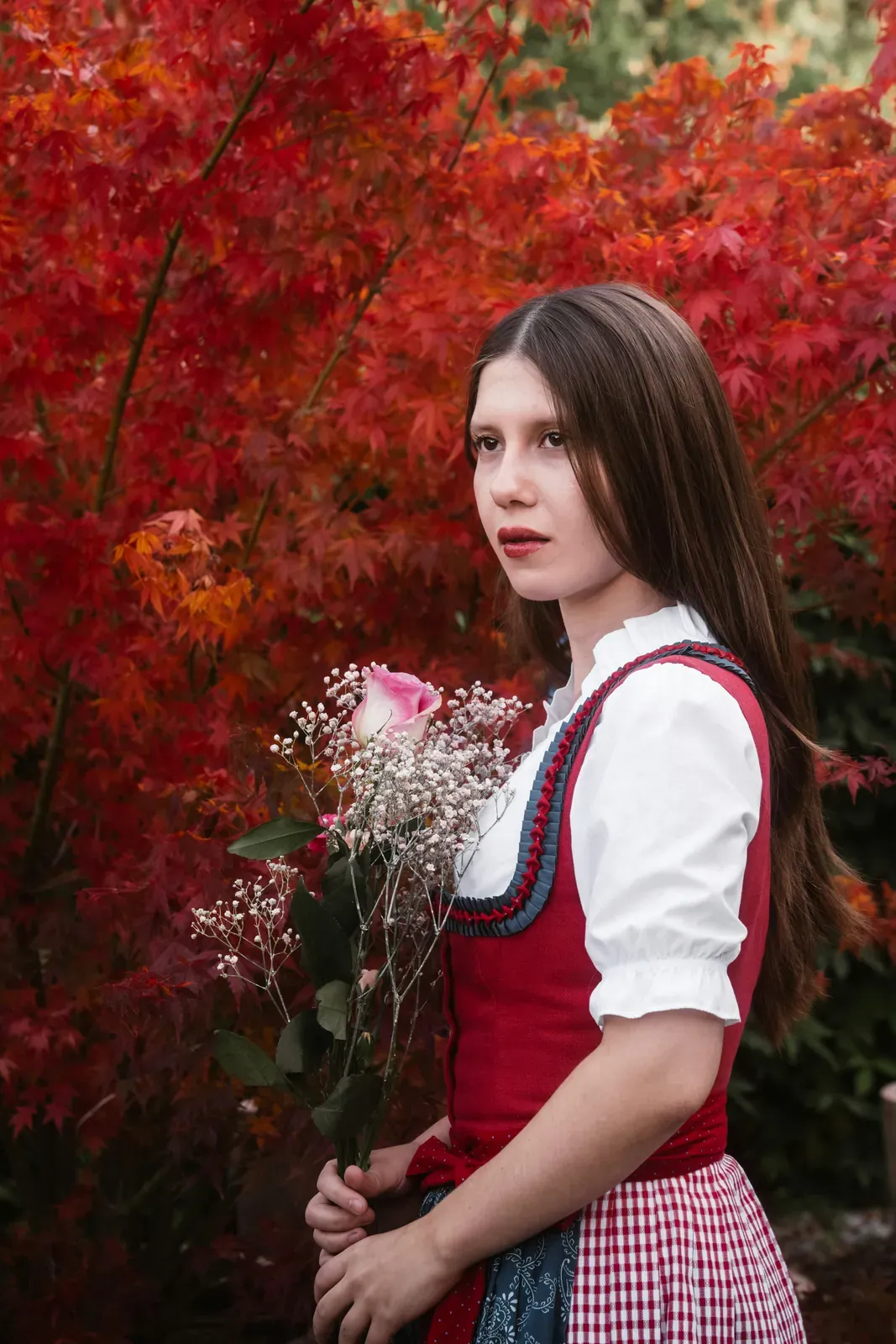
- Bodice (Mieder): the fitted upper part, closed at the front with hooks, buttons, lacing or a zip. It is usually sewn to the skirt, so the dress itself is one piece.
- Skirt (Rock): gathered or pleated at the waist and wide at the hem. Traditional dirndl reach at least to the calf; fashion versions are also made at knee length or shorter.
- Blouse (Dirndlbluse): a short blouse, usually white, worn under the dress. Sleeves range from small puff sleeves to long sleeves for church and cooler seasons.
- Apron (Schürze): tied around the waist, usually a little shorter than the skirt and often in a contrasting colour or pattern.
- Accessories: a knitted cardigan or wool jacket, a shawl over the shoulders, a necklace and low shoes.
Everyday and festive styles
- Everyday or work dirndl: cotton or linen in simple checks, stripes or small prints, with a practical apron.
- Festive dirndl (Festtagsdirndl): silk, brocade or fine wool, often in richer colours and sometimes with embroidery or trimmings, worn to church and celebrations.
- Bridal dirndl (Brautdirndl): an especially elaborate festive dirndl, often of silk.
- Regional dirndl: many valleys and districts in Bavaria and Austria have their own combinations of colours, fabrics and cut, recorded and promoted by local Tracht associations.
- Fashion dirndl: modern designs in any colour or fabric and in many skirt lengths, sold mainly for Oktoberfest and other festivals.
How it is worn
The blouse goes on first, then the dress, which is closed at the front. The apron comes last and is tied with a bow. A popular modern convention says that the position of the bow shows the wearer’s relationship status: on the left for single, on the right for married or in a relationship, at the back for widows. The rule is widely repeated, but its age is unclear and many historical regional costumes do not follow it.
With a dirndl, women usually wear low-heeled shoes or ballet flats and add a cardigan, jacket or shawl in cooler weather. The photo above shows a typical combination: a red bodice, a white puff-sleeved blouse and a checked apron.
When it is worn today
In Bavaria and Austria the dirndl is worn at Oktoberfest and other folk festivals, weddings, christenings, church holidays, village festivals and Tracht association events. Staff in traditional inns and beer halls often wear it at work, and some women put on a dirndl for Sunday church or family celebrations. Outside the Alpine region it is mostly seen at Oktoberfest-style events.
See traditional clothing in Germany for the festivals where the dirndl is most common, and the regional Trachten of other parts of Germany, which look quite different.