History
Weaving in the Andes goes back thousands of years, and cloth was highly valued in the Inca state. Inca men wore the unku, a tunic sewn closed at the sides. The poncho, which is left open at the sides, is widely thought to have become common during the colonial period, possibly developing from earlier Andean garments. Its exact origins, and the origin of the word itself, are still discussed by historians.
Over time the poncho spread far beyond the highlands. Today it is worn in Peru, Bolivia, Ecuador, Colombia, Chile and Argentina, among other countries, by Indigenous communities, farmers and horsemen alike. The gauchos of the Argentine and Uruguayan plains and the huasos of central Chile each developed their own styles.
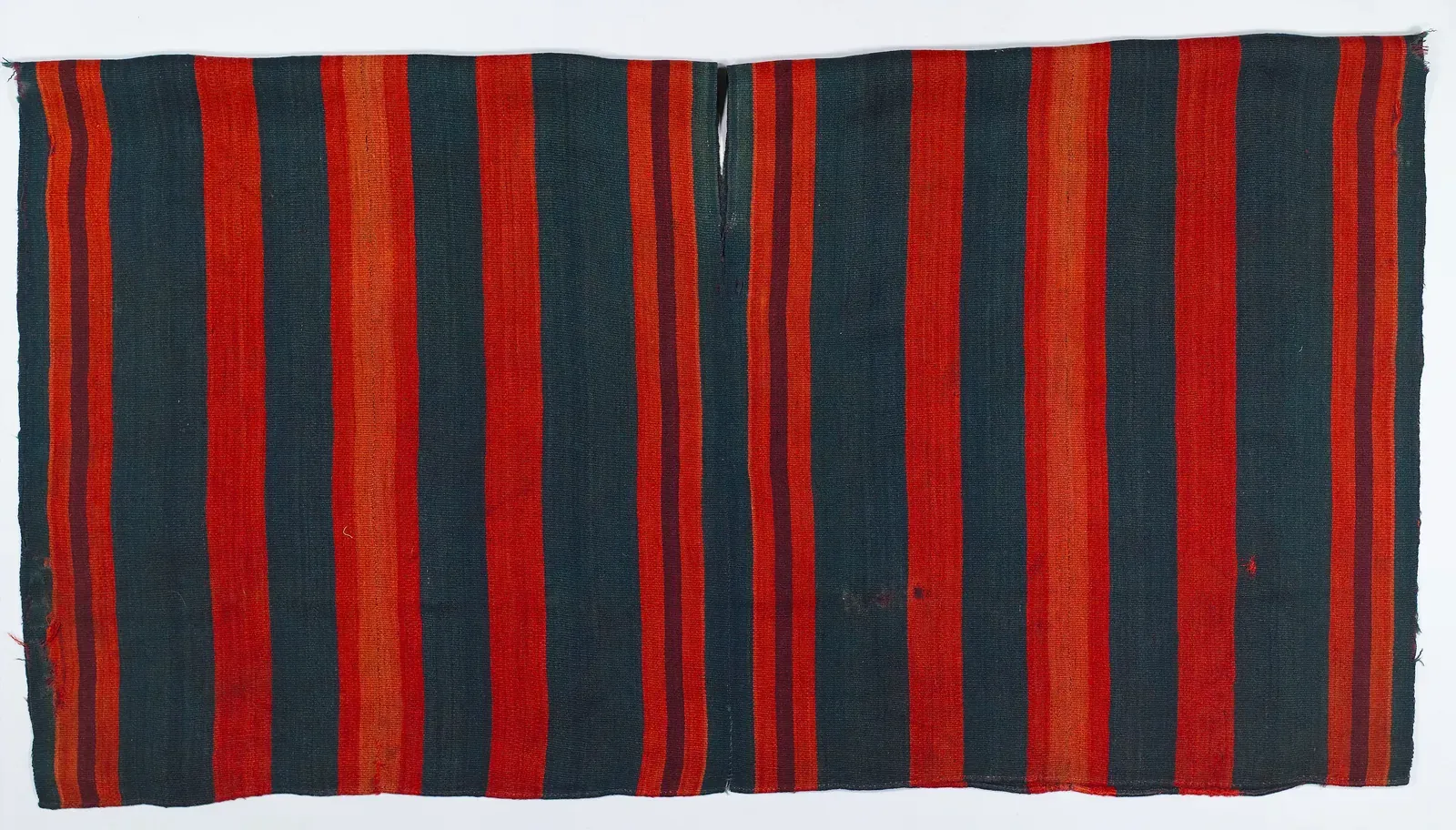
The poncho in the photo above belongs to the Metropolitan Museum of Art in New York. The museum describes it as Quechua and gives its date as “17th century (?)”, with a question mark, because the exact age is uncertain.
Materials and weaving
Andean ponchos are traditionally woven from:
- Alpaca wool, which is soft and warm.
- Llama wool, which is coarser and hard-wearing.
- Sheep’s wool, introduced by the Spanish and now widely used.
- Cotton, especially for lighter ponchos in warmer areas.
Many ponchos are woven on a backstrap loom or a treadle loom. Because the width of the loom limits the size of the cloth, a poncho is often made of two panels that are sewn together along the middle, leaving a slit for the head, as in the museum example. Andean weavers traditionally weave each panel to its finished size, so the cloth does not need to be cut. Colours come from natural dyes, such as red from cochineal, or from synthetic dyes.
Styles
- Everyday highland ponchos: heavy wool ponchos that protect against cold, wind and rain at high altitude.
- Festive ponchos: finer ponchos with stripes and woven patterns typical of a particular community, worn at festivals and important events. In Peru, colours and designs differ from one community to the next.
- Chamanto: a finely woven poncho from central Chile, associated with the huaso horseman.
- Argentine ponchos: in northern Argentina, the red and black poncho of Salta is one well-known regional style.
- Modern ponchos: fashion ponchos and rain ponchos, which borrow the shape but not the weaving traditions.
How it is worn
The poncho is pulled over the head through the neck opening so that it rests on the shoulders and falls loosely at the front and back. Because it is open at the sides, the arms stay free. In cold weather it can be wrapped closer around the body, and when working it is often thrown back over the shoulders. Lengths vary from hip-length to below the knee. In the Andes it is often worn with a knitted chullo hat and sandals called ojotas.
When it is worn today
In high Andean communities, the poncho is still everyday clothing for many men. Festive ponchos are worn at community celebrations, dances and religious festivals, and at weddings. Ponchos are also sold to visitors through weaving cooperatives and markets. See traditional clothing in Peru for more on Andean weaving and the dress worn with the poncho.