History
Draped, unstitched garments have a long history in South Asia. Sculptures and texts from ancient India show people wearing a cloth wrapped around the lower body, sometimes with a second cloth over the shoulders. The word sari is usually traced to the Sanskrit śāṭī, meaning a strip of cloth.
For a long time, many women in different regions wore the sari without a blouse or petticoat, or with local forms of both. The fitted blouse and the petticoat became standard in many regions in the late 19th and early 20th centuries. In Bengal, Jnanadanandini Devi of the Tagore family is often credited with helping to popularise a way of wearing the sari with a blouse. Over the 20th century the nivi drape spread widely. Today the sari is worn in India, Bangladesh, Nepal and Sri Lanka, and by some women in Pakistan.
Parts of a sari
- Body: the main length of the cloth, plain or patterned.
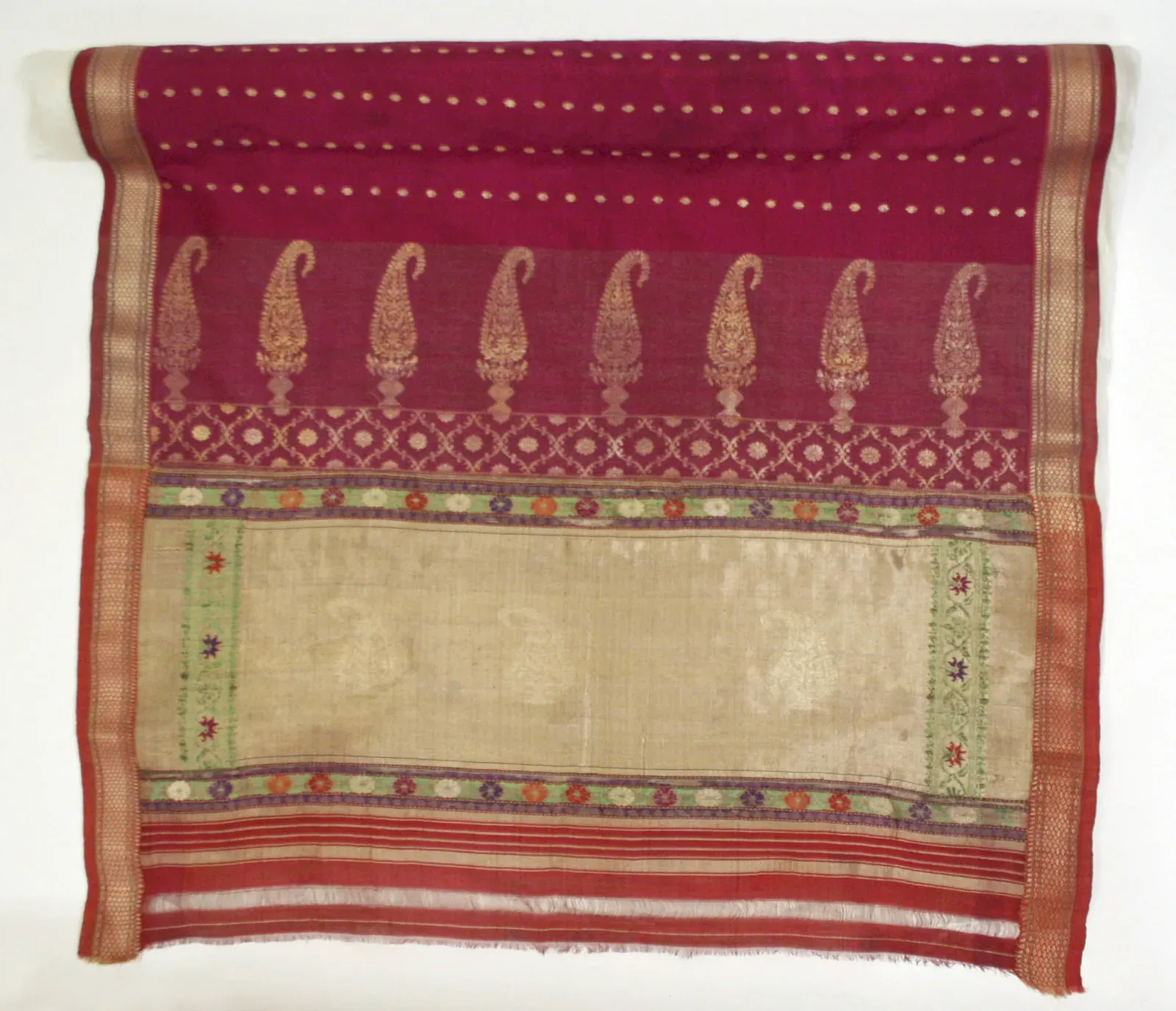
- Border: woven or embroidered edges along the length, often in a contrasting colour or with metallic thread.
- Pallu: the decorated end that hangs over the shoulder, usually the most elaborate part. The photo above shows the end of a silk sari from about 1875, decorated with large paisley motifs.
- Blouse: a fitted, often short top. Many saris are sold with an extra length of matching fabric for sewing the blouse.
- Petticoat: an ankle-length underskirt tied at the waist with a drawstring, into which the sari is tucked.
Regional weaves
Saris are woven in cotton, silk and many other fibres, and many regions have their own well-known styles:
- Banarasi (Varanasi, Uttar Pradesh): silk with brocade patterns in gold or silver thread (zari), a popular choice for weddings.
- Kanchipuram (Tamil Nadu): heavy silk with wide borders in contrasting colours.
- Paithani (Maharashtra): silk with zari, known for motifs such as peacocks on the pallu.
- Baluchari (West Bengal): silk with a pallu showing woven scenes, often from the epics.
- Patola (Gujarat): double ikat, in which both warp and weft threads are dyed before weaving.
- Chanderi (Madhya Pradesh): a light, sheer fabric of silk, cotton or a mix of both.
- Kasavu (Kerala): off-white cotton with a gold border.
Drapes
The same cloth can be draped in many ways:
- Nivi: the most widespread style today. Pleats are tucked in at the front and the pallu falls over the left shoulder.
- Nauvari: a nine-yard drape from Maharashtra, passed between the legs and tucked in at the back, which gives it a trouser-like shape.
- Gujarati style: the pallu is brought from the back over the right shoulder so that it hangs down the front.
- Kodava style: from Kodagu in Karnataka, with the pleats tucked in at the back and the pallu over the right shoulder.
How it is worn
A simple way to put on a sari in the nivi style:
- Put on the blouse and tie the petticoat firmly at the waist. The petticoat is often chosen to match the colour of the sari.
- Tuck the plain end of the sari into the petticoat at the front and wrap it once around the body.
- Drape the pallu across the body and over the left shoulder, so that it falls down the back.
- Gather the remaining fabric into even pleats and tuck them into the waistband at the front.
Many people pin the pallu to the blouse at the shoulder and pin the pleats to keep them in place. Draping a sari neatly takes practice, and relatives often help with formal saris.
Occasions today
For many women, especially in some regions and among older generations, the sari is everyday wear. Others keep it for special days: weddings, festivals, religious ceremonies, graduation events and formal functions. Silk saris such as Banarasi and Kanchipuram are traditional choices for brides and wedding guests. See traditional clothing in India for bridal saris and other wedding wear.